

New Zealand has quietly become one of the most attractive destinations for students who want a world-class education without leaving their family behind. If you are planning to pursue a New Zealand Masters study visa, here is something that will make your decision even easier — your spouse does not have to sit back home while you study. Under current immigration rules, your partner can travel with you and receive a New Zealand spouse open work permit, allowing them to work full-time while you focus on your degree. Let’s break down everything you need to know.
🎓 Why Choose a Masters in New Zealand?
New Zealand universities are globally ranked, research-focused and offer practical, industry-aligned programs across engineering, business, IT, health sciences and more. Beyond academics, the country offers a safe environment, stunning landscapes and a genuinely welcoming culture for international students.
For Indian and South Asian students especially, New Zealand is now competing strongly with Canada and Australia — and for good reason.
📋 Key Highlights at a Glance
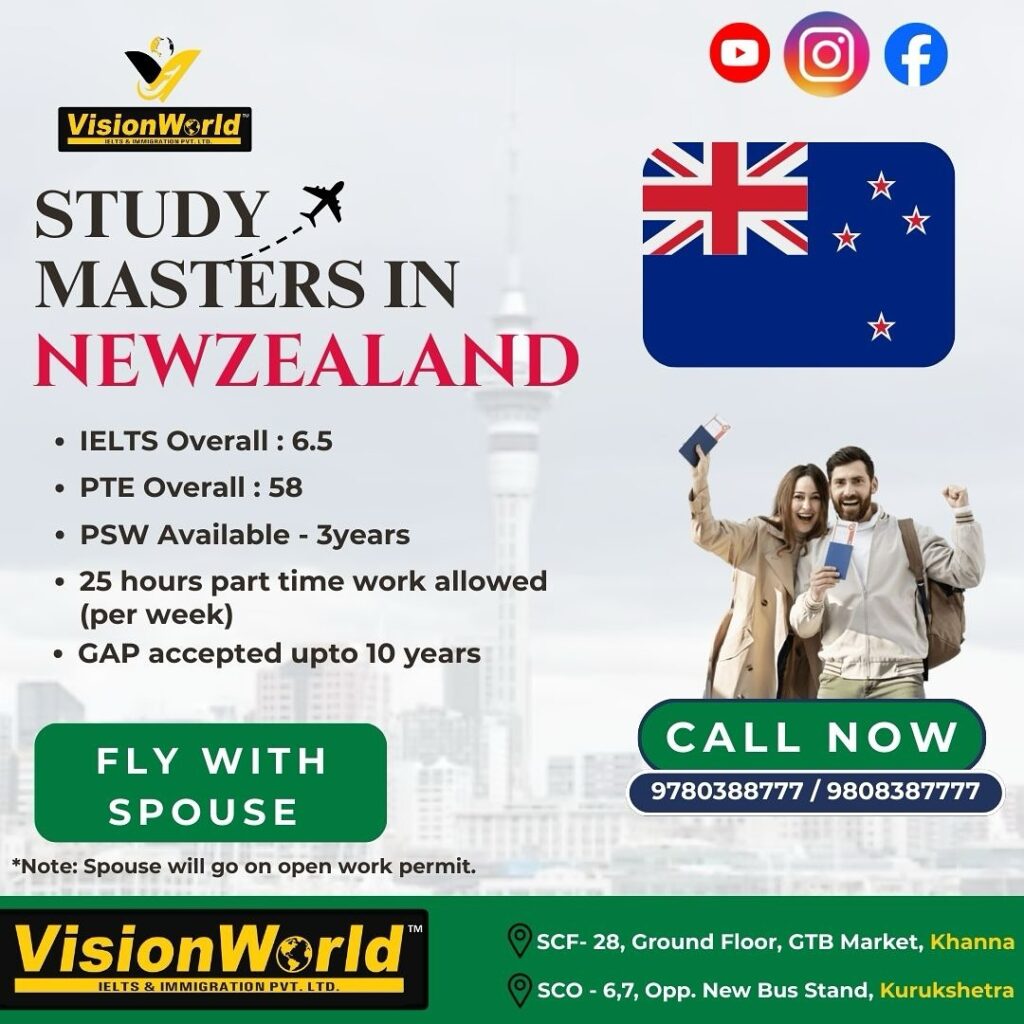
- 🎓 Course: Masters in New Zealand
- 🌏 Country: New Zealand
- 📊 Language Requirements: IELTS Overall 6.5 / PTE Overall 58
- 💼 Work Rights: 25 hours part-time work per week during studies
- 📋 Post Study Work (PSW): Available — up to 3 years
- 👫 Spouse Benefit: Fly together + Spouse gets Open Work Permit
- ✅ Gap Year: Acceptable with proper justification
📊 Language Requirements — What You Need
To be eligible for a Masters program in New Zealand, you need to meet the English language requirements set by universities and Immigration New Zealand:
- IELTS: Overall band of 6.5
- PTE Academic: Overall score of 58
These are standard requirements for most Masters programs and some universities may have slightly higher thresholds depending on the course. Always verify with your chosen institution before applying.
💼 Work Rights During Your Studies
One of the biggest advantages of studying in New Zealand on a student visa is the built-in work rights. As a Masters student, you are allowed to work up to 25 hours per week part-time during your study period. This gives you the opportunity to gain local work experience, cover your living expenses and build professional connections — all while completing your degree.
👫 Spouse Benefit — The Real Game-Changer
This is where New Zealand stands out. Unlike many other countries where your spouse has limited or no work rights, New Zealand allows your partner to come along and receive a New Zealand spouse open work permit. This means your spouse can work for any employer, in any role, without restrictions — significantly reducing your financial burden and keeping your family together.
It’s a practical and humane policy that makes New Zealand one of the most family-friendly study destinations in the world right now.
📋 Post-Study Work (PSW) — What Happens After You Graduate?
After completing your Masters, you are eligible for a Post Study Work (PSW) visa of up to 3 years. This gives you ample time to find employment in your field, gain skilled work experience and build a pathway toward New Zealand permanent residency.
Three years is a substantial window and many graduates use this time to transition into skilled migrant residency pathways.
✅ Gap Year — Is It Accepted?
A common concern among applicants is whether a gap year will hurt their application. The good news is — gap years are acceptable, as long as you provide a proper justification. This could include work experience, family responsibilities, health reasons, or financial planning. Immigration officers evaluate applications holistically, so a well-documented explanation typically resolves any concerns.
❓ Frequently Asked Questions (FAQs)
Q1. Can my spouse work full-time on a New Zealand spouse open work permit? Yes. The spouse open work permit in New Zealand is an open permit, meaning your spouse can work for any employer and in any occupation without restrictions. No specific job offer is required.
Q2. What IELTS score do I need for a Masters in New Zealand? You need an IELTS overall band of 6.5. Some programs may require higher scores. PTE Academic score of 58 is the equivalent alternative.
Q3. How long is the Post Study Work visa after completing a Masters? After completing a Masters degree in New Zealand, you are eligible for a Post Study Work (PSW) visa of up to 3 years, allowing you to work for any employer across New Zealand.
Q4. Is a gap year acceptable for a New Zealand Masters student visa application? Yes, a gap year is acceptable with a valid and well-documented justification — such as work experience, financial preparation, health issues, or family responsibilities.
Q5. How many hours can I work as a Masters student in New Zealand? As a Masters student, you are permitted to work up to 25 hours per week part-time during your study period. During scheduled breaks, you may be able to work full-time.
Q6. Can studying in New Zealand lead to Permanent Residency? Yes. Completing a Masters degree and working on a Post Study Work visa puts you in a strong position to apply for New Zealand Permanent Residency through the Skilled Migrant Category or other residency pathways.
🏁 Conclusion
Studying a Masters in New Zealand is more than just an academic investment — it is a life decision that benefits your entire family. With 25 hours of weekly work rights, a 3-year post-study work visa, your spouse eligible for a full open work permit and gap years considered with justification, New Zealand ticks every important box for international students. If you are serious about making this move, expert guidance can save you time, stress and costly mistakes. VisionWorld Immigration specializes in New Zealand student visa applications and can walk you through every step of the process — from documentation to arrival.
